The So-called Reading Wars Most Specifically Are Related to
Reading Wars and "The Science of Reading"
Reading Instruction through the decades
"Today a reader, tomorrow a leader" — Margaret Fuller
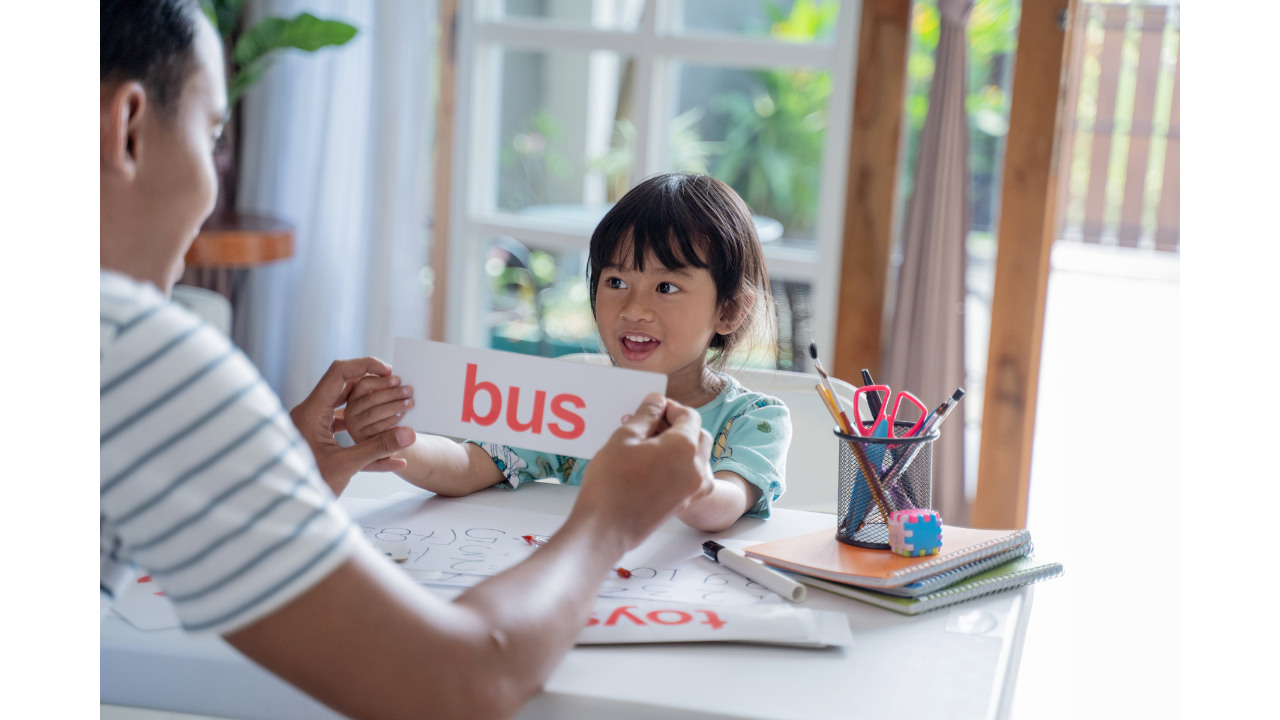
Teaching children to read is undoubtedly the nearly of import and challenging responsibleness an early primary instructor will face. Merely only how practice children learn to read and what is the best method to teach them? While the debate in methodology and pedagogy will likely go on, what we can all agree on is that teaching reading is not a "one size fits all" approach and not ane method works for every child.
I've been in the field of elementary teaching for over 25 years. In that time, I take witnessed, first paw, what is known in the education world as " The Reading Wars " — the back and along debate over which method is "the best" one to teach our students how to read. Since the 1980s, there has been much debate between supporters of explicit phonics instruction and those who favor a whole-linguistic communication approach. In my years of teaching, I have seen the reading educational activity pendulum swing back and forth between these 2 approaches numerous times, sometimes swinging completely to one side or the other, other times landing somewhere in between. With each dramatic swing, there is a buzz followed apace by a new curriculum, a new sleeky box of shiny objects, and a consummate shift in the landscape of reading instruction. Afterwards a period of consistent calm over the by 10 years, there is a new fizz in the air… (pulsate roll, please!)… The Science of Reading!
Merely what is the Scientific discipline of Reading and why all the fizz? Well, before I reveal what I've learned about "SoR" (now you lot know something is "hot" if there is an acronym for it!), I thought information technology might be helpful to look back on some of the most well-known methods of reading teaching over the past 50 years to give you lot some context about where nosotros have come from and where nosotros are heading.
WHOLE WORD METHOD — mid 1960's — 1970'due south
This is Janet.
This is John.
See Janet run.
See John run.
Go, Janet! Run, run, run!
Go John! Run, run, run!
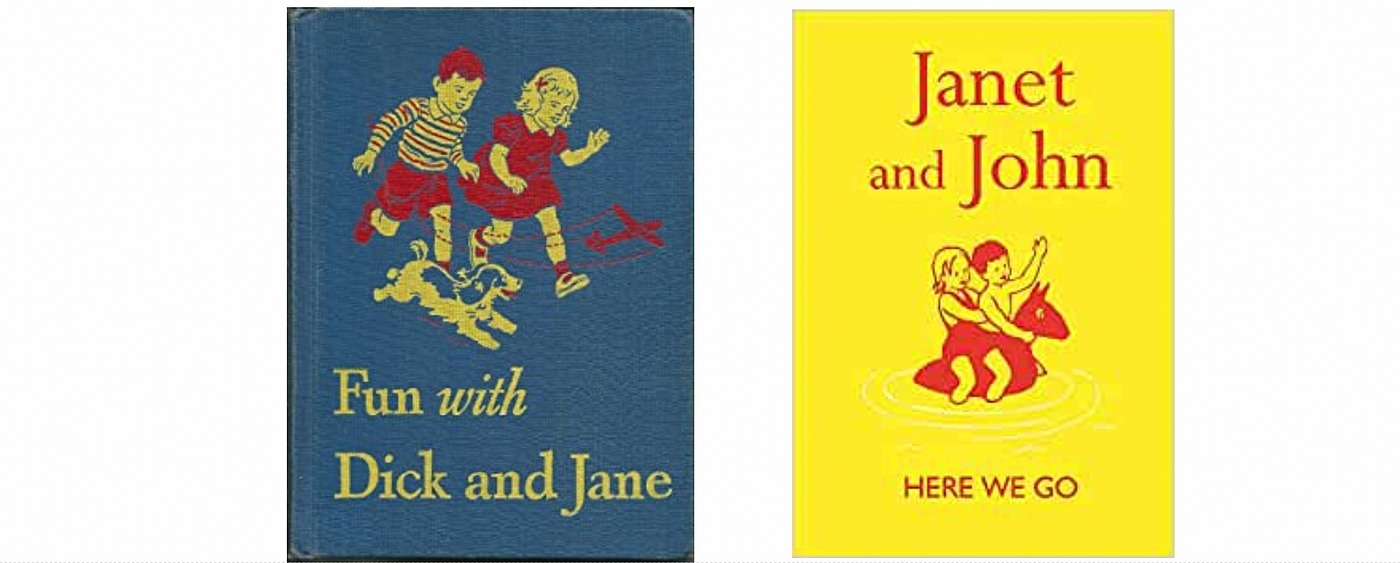
If you recognize this, you probable went to simple school when I did in the belatedly 60'south or early lxx's (yes, I'm that onetime!) and learned to read with Dick and Jane and Janet and John . These showtime readers were very repetitive and were compiled of an intentional sequence of simple sight words. This method of reading whole words became known as the "Wait/Say" method, whose principal purpose was to learn and drill sight words. (I can however remember "flash card" drills in grade 1!) Once children learned (memorized) 30–50 sight words, they were given repetitive readers, commonly referred to equally "basal readers", consisting largely of these words. Unknown words are often accompanied by a picture to assistance in identification. Dick and Jane illustrated basal readers were the most famous books of this menstruation. The serial was a great success and by the late 1960's both the Dick and Jane and Janet and John books were being used in 70% of North American and British schools to teach reading. According to the times, memorizing sight words and reading them in context was "the best" mode for students to acquire to read.
WHOLE LANGUAGE METHOD — 1980's
By the mid 1970's the Janet and John books were outdated and some questions were being raised about a lack of multifariousness in the stories and the fact that they represented a rather "nuclear" white, middle-class family. New inquiry and theories were also being developed on how children learn to read better when engaged with "real" stories rather than the artificial, contrived stories found in basal readers. Enter — " Whole Language ", developed past Kenneth Goodman and Frank Smith in the tardily 1970's, a "meridian down" approach to reading where readers construct meaning of a text based on personal connections and experiences. The advantage of the whole language approach is that it exposed children to "existent" literature and made reading more meaningful. Stories were read to the children, allowing them to engage and experience accurate literature and focus on comprehension and meaning-making. Writing was also emphasized in the early stages of reading and children were encouraged to write from their experiences and use invented spelling.
The bug surrounding the Whole Language approach was that phonics and the systematic teaching of code and sound-symbol correspondence was of a sudden rejected. Although phonics, decoding, and spelling were addressed in give-and-take study and within the context of emergent writing, they were not explicitly or systematically taught. Unfamiliar words were identified, non by sounding it out, merely by "asking somebody what the give-and-take is" — or past guessing what the word might be using the context. Whole language was based on the idea that learning to read should be equally like shooting fish in a barrel and natural as learning to speak. Children would "observe" the necessary letter of the alphabet/sound relationships as they read books and expressed themselves in writing, using their invented spellings. Despite the lack of scientifically based research into the effectiveness of Whole Linguistic communication, however, it spread throughout North America at an unprecedented pace.
Balanced Literacy — Guided Reading, Levelled Texts, Cueing System 1990'due south-2000's
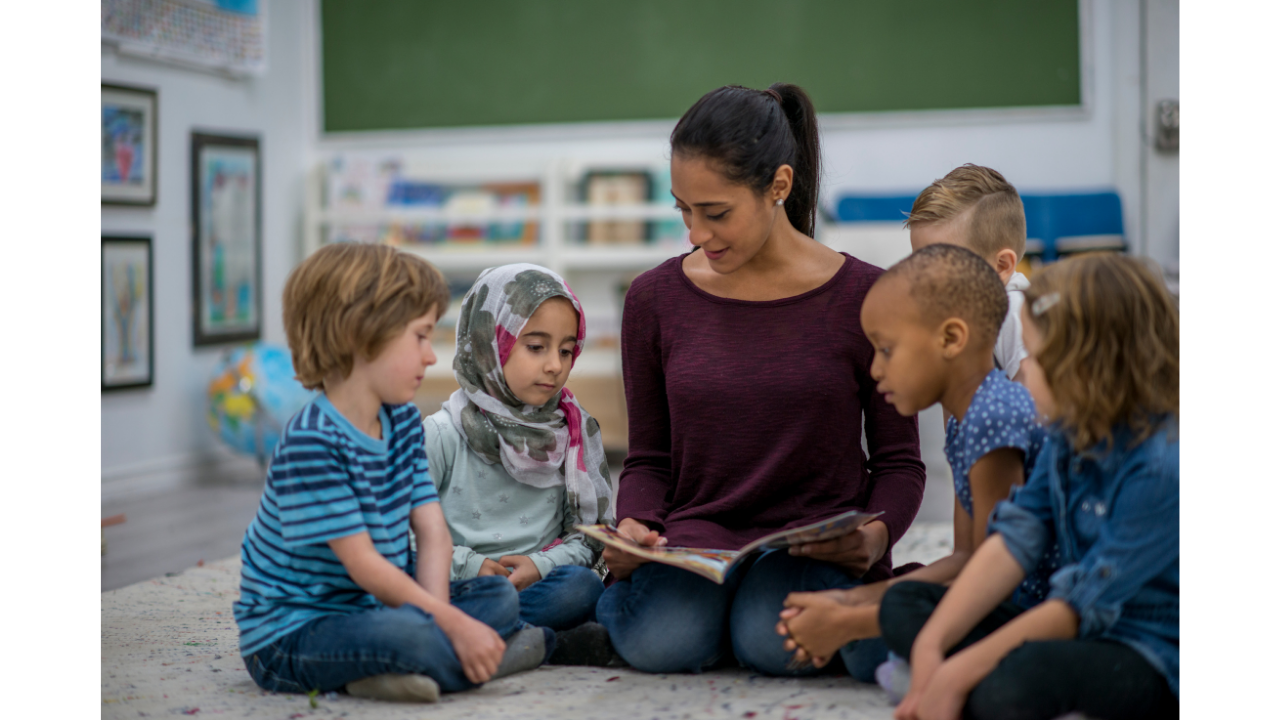
Non surprising, afterwards over ten years of Non teaching students how to read words, many couldn't! Reading is not as natural a process as speaking and immersing students in print and literature alone will not teach them how to read. So the reading pendulum swung back and landed somewhere in the middle with what was referred to as "Counterbalanced Literacy". Engaging students in accurate literature, focusing on meaningful reading experience was even so at the forefront, but incorporating explicit, targeted instruction in phonics and phonemic awareness was dorsum on the table.
Nigh significantly, Counterbalanced Literacy introduced a "levelled text" arrangement into reading pedagogy, allowing children to progress from simple to more complex texts as they developed more skills. Reading assessments tools were introduced (DRA, Benchmarks) to make up one's mind what level a child was reading at. Teachers would and then match students to levelled books that were challenging enough for them to make progress. These texts focus on 'significant' and repeatedly utilize 'high frequency' words (said, where, out) and syntactic patterns.
Counterbalanced Literacy focused on providing a variety of reading opportunities for students: shared, guided, partner, and independent reading. Reading groups, small-grouping instruction or guided reading were introduced, high frequency words memorized, book rooms were filled with bags of levelled texts and reading assessments and running records were essential components of a counterbalanced reading program.
In this balanced arroyo, students were taught what is known every bit a "cueing organization", known as "MSV", which promotes attempting to read unfamiliar words past drawing from semantics (context clues, pictures, background knowledge), syntax (employ of language patterns), or graphophonic cues (sounding out words). The claim was that, since reading is more or less a guessing game, the purpose of reading instruction is to teach students issue strategies to deduce unfamiliar words by drawing from meaning, knowledge of the alphabet, and cognition of how English language works.
When encountering an unknown word, students were taught to gauge, while asking themselves:
Does it brand sense? (Meaning)
Does it sound correct? (Structure)
Does information technology look right? (Visual)
"Counterbalanced Literacy" has been the foundation of the majority of Main classrooms for the by 10 years but just recently, the winds have shifted and it appears a change is on the horizon.
The Science of Reading 2020
It is hard to hear that something you've believed in and used successfully for years is non the best teaching method for your students. I am amidst thousands of educators who successfully used a "Balanced Reading" arroyo for the past ten–15 years. Word on the street now, however, is that it may not exist doing the task. The argument is that reading is not a guessing game and teaching young children to look at pictures, skip over words, or guess at words based on context may non develop appropriate strategies necessary for reading proficiency.
So at present what? The pendulum is about to swing again… lookout your head…
Make way for "The Scientific discipline of Reading"!
Like for many of y'all, The Science of Reading is a relatively new concept for me. In fact, information technology is only this past year that I have defenseless the buzz. Let me be articulate — I am not an expert in SoR. Simply after a lot of reading, I have a clearer understanding of what it is and isn't.
Outset and foremost, the Science of Reading (SoR) is not a program, a shiny object, or a "one size fits all" approach to reading instruction. The term "science of reading" refers to the broad body of research that reading experts, particularly cognitive scientists, have conducted over the past 20 years on how we larn to read. SoR helps united states sympathize the specific cognitive processes essential for reading proficiency: which skills are involved and what parts of the brain are at work in the process. (Now, I'm all about metacognition and brain office and then this is VERY appealing to me!)
When exercise is called into question in instruction and begins to shift, it is due primarily to research. And so what does the research tell u.s.a.? Leading the way in this research is Stanislas Dehaene, whose 2009 quantum book "Reading in the Encephalon: The New Science of How We Read" is among the almost referenced books I encountered. Dehaene, a major advocate of systematic phonics instruction, says:
"The goal of reading teaching is clear. It must aim to lay downwards an efficient neuronal hierarchy, so that the child can recognize letters and graphemes and easily turn them into voice communication sounds." (Dehaene 118)
The SoR inquiry strongly believes that the most bones first steps to becoming a reader are phonemic awareness (understanding sounds in spoken words) and understanding phonics (knowing that messages in print correspond to sounds). Research shows that students acquire to read when they are able to identify letters or combinations of letters and connect those letters to sounds. (Of course, comprehension and attaching significant to those words is equally important.) If a child doesn't chief phonics, they are more likely to struggle to read. That'due south why researchers are saying that explicit, footstep-by-step, systematic educational activity in phonics is essential. Once they learn how to decode words, they can then apply that skill to more challenging words and ultimately read with fluency and proficiency.
What surprised me, equally I learned more near the Science of Reading, is that it is non Only virtually instruction phonics. It identifies and emphasizes explicit pedagogy in these essential reading skills:
- Phonological awareness — spoken communication, identifying words that rhyme, recognizing alliteration, syllables, segmenting a sentence into words
- Phonics — intense, and systematic teaching in letter of the alphabet-sound correspondence
- Fluency — read aloud strategies — pace, phrasing, punctuation, intonation.
- Vocabulary — word knowledge — understanding of words and their meanings
- Comprehension — comprehension strategies — predicting, summarizing, connecting, inferring, etc.
If you lot are thinking that this sounds very much like your current "Counterbalanced Reading" program, you would be correct. Then how is SoR different? Once again, it comes back to the phonics instruction. The Science of Reading arroyo believes that a prevention-oriented approach is more effective than intervention and that systematic, explicit instruction for all learners is the key: "Performance is all-time when children are, from the very beginning, straight taught the mapping of letters onto speech sounds. Regardless of their social background, children who do non learn this suffer from reading delays." (Dehaene 209)
Finally, the SoR believes that, along with a systematic phonics program, emergent readers need practise applying their phonics skills with decodable texts — highly anticipated, decodable texts with patterns and repetitions of controlled vocabulary.
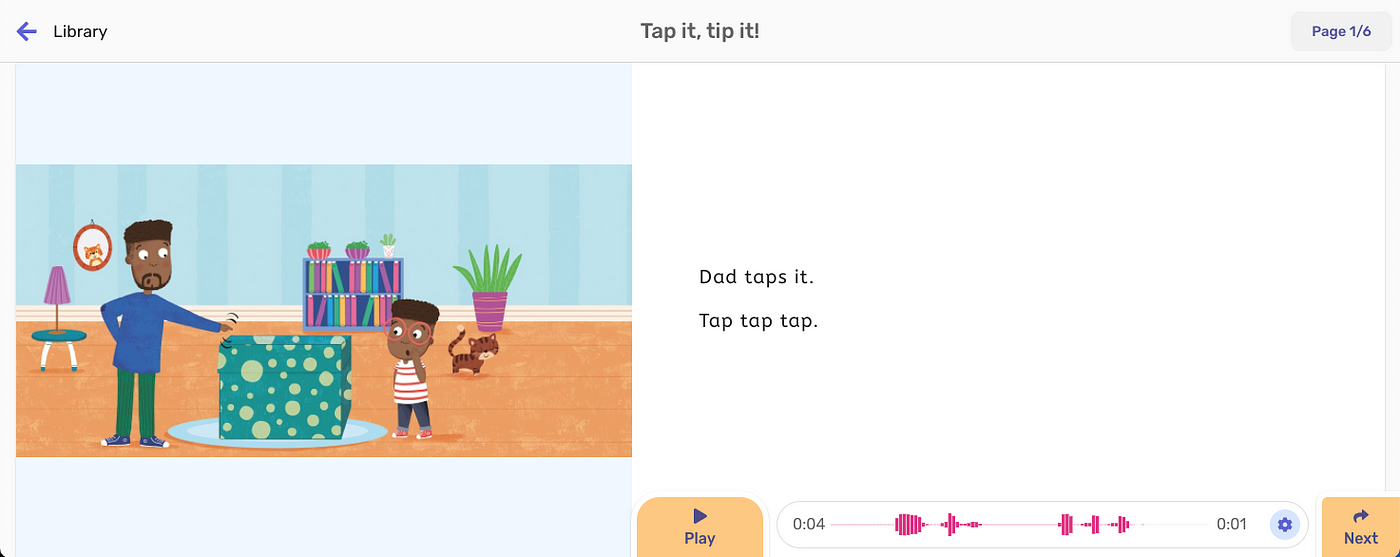
These "decodables" often audio zero similar natural everyday speech and, like the Dick and Jane books, provide niggling opportunity for deep thinking. They do, nonetheless, provide readers with opportunities to decode the words and utilize the phonic skills they have learned. In contrast, many levelled texts are often predictable, repetitive, and highly dependent on context and illustrations and so readers often don't rely on the print or decode the words because they simply don't have to.
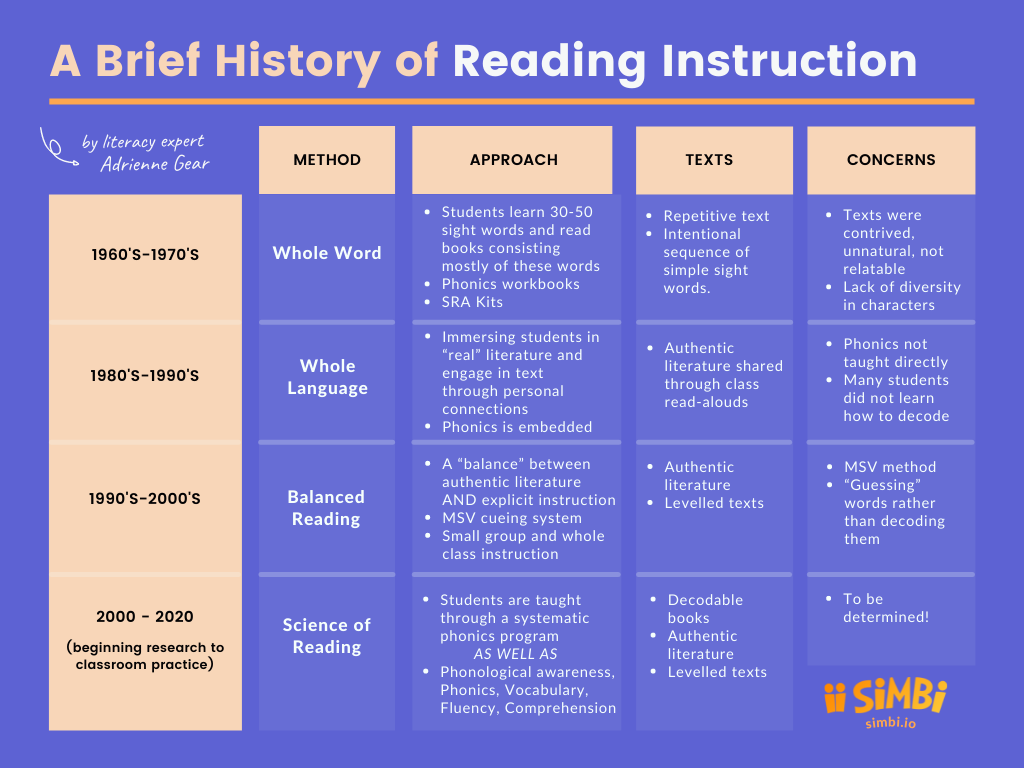
Now only in case that was a chip wordy for your liking, below is a summary of the different reading instruction methods explained in a higher place in a nautical chart (I love charts!)
SoR in the Classroom
Every bit mentioned, I am no expert in the Scientific discipline of Reading, nor am I a scientist or a researcher. Simply I am a teacher and ultimately, we all have the aforementioned goal: that students walk out of our classrooms better readers than when they walked in. Achieving this goal ways being informed, taking risks, asking questions, and beingness responsive to how our students acquire to make sense of print. And they won't all make sense of print in the same way: some may succeed more than with leveled texts while others may learn best with decodables; some may be natural meaning makers, while others require more explicit comprehension educational activity.
Has the pendulum started to swing? I would say yep. But alter is expert. And if we can "bring with the swing" some new knowledge of all that has come before the SoR movement, we are better equipped to make informed decisions about what we can do to support our offset readers. Above all, the key is "balance". Nosotros know that in that location will e'er be a broad range of readers in our classrooms and that there is no one arroyo that works for all of them. The best reading teachers are informed, responsive, and accept the time to reflect and refine what they know works best for each student. Equally we have learned, SoR isn't completely new and if you lot have been following a Balanced Literacy approach, it may have only a few small, manageable, intentional shifts in your do to brand a big touch on your students' reading success.
SoR at Dwelling house (feel costless to use this in your next alphabetic character home to families!)
"Reading aloud with children is known to be the single nearly of import action for edifice the noesis and skills they will eventually crave for learning to read." — Marilyn Jager Adam
For parents of outset and early readers who may wish to support their child at home, hither are a few suggestions:
- Read aloud to your child every day. Interacting with your child and a book is likely the most important thing you tin can do to help them go a reader.
- Read your child'southward favourite book over and over again. Use your finger to model tracking the words as you lot read. For books that children know well, invite them to use their finger to follow along as you read each word.
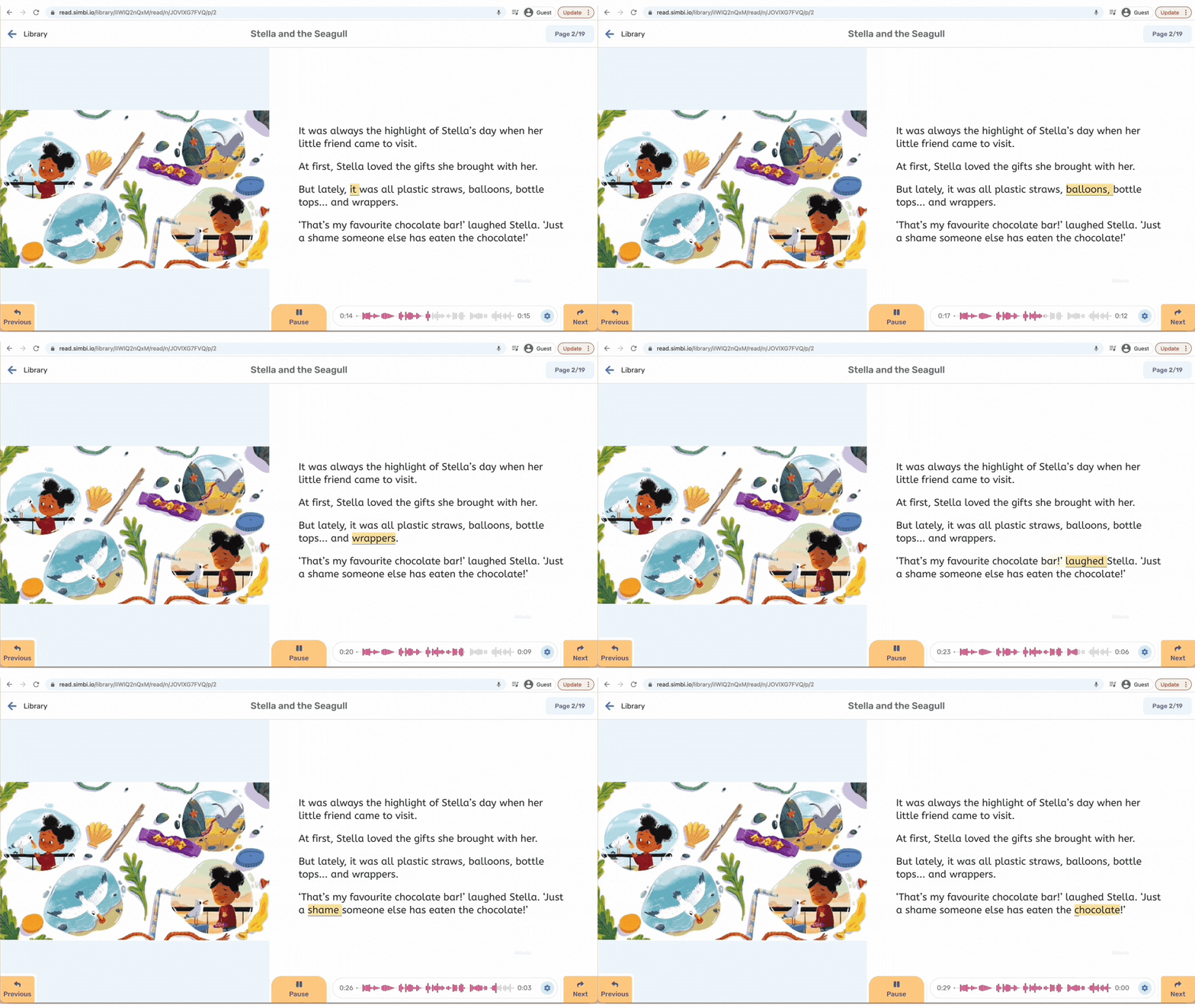
- Take advantage of Simbi'south Read Along characteristic that highlights the words for children as they listen to a narrator read the story.
4. Interact with the story as you read. Intermission, bespeak to a picture or a page and say, "That reminds me of …." or "I'chiliad wondering why….."
5. Stretch out one word in a sentence. Inquire your kid to "drink their milk" but say the individual sounds in the discussion "Grand-I-50-K" instead of the word itself.
6. Inquire your child to figure out what every family fellow member'south name would be if it started with a "B" sound, 'Southward" sound, etc (ie Andrew — Bandrew, Candrew, Sandrew)
vii. Read plant nursery rhymes. Once your kid learns a few, commencement them and have your kid say either the last word or the rhyming word.
8. Sing "I Like to Swallow Apples and Bananas" song — using the different vowel sounds. (here is a video link to the song: https://www.youtube.com/watch?five=r5WLXZspD1M )
nine. Play rhyming games in the car — "What rhymes with dig?" (wig, jig, fig, large)
10. Play letter versions of "I Spy" -
- "I hear with my little ear something that begins with B"
- "I hear with my little ear something that rhymes with _______"
11. Label things effectually the business firm with small word cards to introduce your kid to print — "door" "tabular array" "chair"
Systematic Phonics Programs:
- Heggerty Phonics
- McCracken Spelling Through Phonics — 30th edition (an oldie but a goodie!)
- www.ateachableteacher.com — Peachy website with recommended resource and games for phonemic and phonics skills
- five Shockingly Complimentary Phonics Websites for Kids
- Decodable books on Simbi! Looking for decodable books online? Cheque out our Decodables collection in the Simbi Library.
Recommended resources for exploring the Scientific discipline of Reading:
- Reading in the Brain: The New Science of How We Read by Stanislas Dehaene
- Equipped for Reading Success by David Kilpatrick
- Essentials of Assessing, Preventing, and Overcoming Reading Difficulties by David Kilpatrick
- Phonics from A to Z: A Applied Guide by Wiley Blevins
- Shifting the Balance — past Jan Berkins and Kari Yates
- Brain Words: How the Science of Reading Informs Teaching by J Richard Gentry
- Proust and the Squid: The Story and Science of the Reading Brain past Maryanne Wolf
References:
https://hechingerreport.org/four-things-you-need-to-know-near-the-new-reading-wars/
https://www.readingrockets.org/blogs/shanahan-literacy/what-science-reading
https://www.readinghorizons.com/reading-strategies/didactics/phonics-instruction/reading-wars-phonics-vs-whole-linguistic communication-reading-didactics
https://world wide web.parkerphonics.com/postal service/a-brief-history-of-reading-pedagogy
https://world wide web.breakingthecode.com/10-reasons-three-cueing-ineffective/
https://journal.imse.com/what-is-the-science-of-reading/
https://hechingerreport.org/what-parents-need-to-know-about-the-research-on-how-kids-learn-to-read/
https://world wide web.speechsoundpics.com/science-of-reading-crook-sail
https://www.apmreports.org/episode/2019/08/22/whats-wrong-how-schools-teach-reading
Burkins, January & Yates, Kari. 2021. Shifting the Balance: 6 Ways to Bring the Science of Reading into the Balanced Literacy Classroom. Portsmouth, NH, Stenhouse

Adrienne Gear is B.C. teacher, literacy specialist, workshop presenter, and the author of 7 books on reading and writing teaching for unproblematic educators. She works for Simbi: Read for Practiced (simbi.io) equally a content and curriculum advisor.
For more than information virtually Adrienne or to purchase her books, visit her website at www.readingpowergear.com
The So-called Reading Wars Most Specifically Are Related to
Source: https://medium.com/readwithsimbi/the-science-of-reading-8631f5614a14
0 Response to "The So-called Reading Wars Most Specifically Are Related to"
Post a Comment