How to Upload a Split on Bandcmap
Hands-on Tutorials
Why is Bandcamp profitable and Spotify non?
This report was originally published on Components .
Note, 3/9/2022: My reaction to the Epic acquisition of Bandcamp can be read on Components.
Summary
This report argues that Bandcamp's basic business model of potentiating people'due south diverse impulses to pay for things and allowing those impulses to freely collaborate, modulate, and chemical compound one another has turned the company into one of the most chimerical in Silicon Valley: a assisting startup run on more often than not outmoded applied science. It argues that this contrasts to Spotify¹, which routinely loses money due to that company's ultimate long-term ambition of monopolization and the removal of the human musician entirely. Finally, it argues that Bandcamp's marketing and software development efforts, while good intentioned or at least neutral, go out enormous potential for growth untapped.
Introduction
When it launched in 2008, Bandcamp'southward founders envisioned the site equally a "publishing platform for musicians" that would do for recording artists what WordPress and Blogspot had done for writers: offer them the ways of maintaining a reliable, fully customizable spider web presence. But in giving musicians the ability to upload songs and albums to their pages, Bandcamp's engineers soon realized they had stumbled into an architecture for a grassroots online marketplace, ane that represented an highly-seasoned alternative to the then-ascendant iTunes Store. Rather than follow Apple'southward lead and prepare a standardized price structure, Bandcamp looked instead to the example set past Radiohead the year before, when the pick to grant fans the ability to pay whatever they wanted to download In Rainbows turned the album into a global awareness. "Perhaps your album's 200 tracks and you lot spent x years on information technology," Ethan Diamond, one of Bandcamp'south founders, said in a contempo interview. "Just yous should be able to set the price yourself because y'all know your audience meliorate than we do, and if somebody wants to come along and pay more y'all set equally that minimum, then great."
Bandcamp publishes the sale of each detail through a live feed on its homepage. We retrieved that information through the endpoint that powers this sales feed once per minute, since hitting the endpoint more ofttimes did non yield more results. We and so joined that information with data from individual albums, which were retrieved separately. In total, roughly 6.seven one thousand thousand sales were logged, and a little more 1.2 million albums were successfully retrieved.
Assay
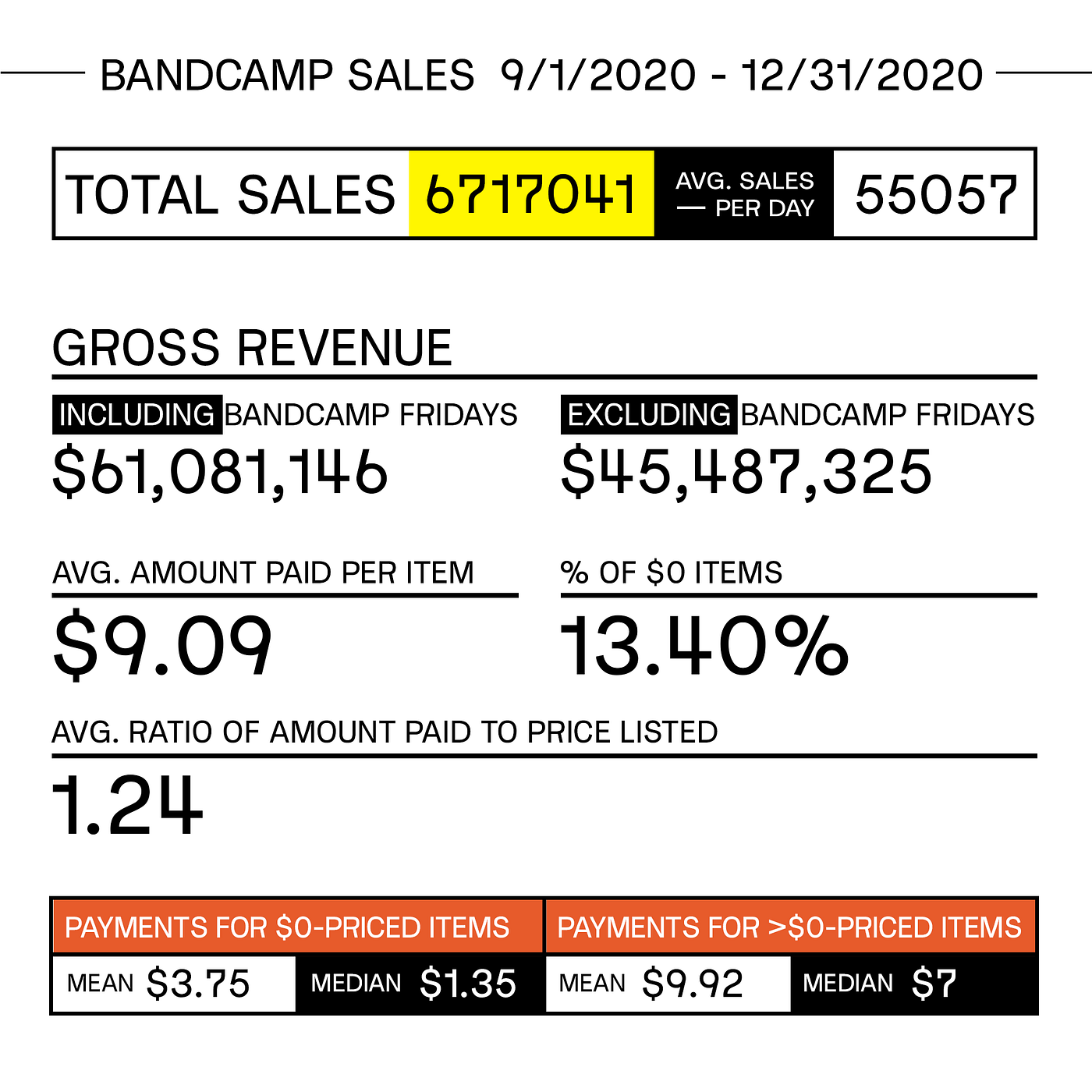
Here's a brief overview of action on the platform between the beginning of September and the end of Dec 2020. Many of these numbers we'll pause down in more than item as we continue, and we'll use a lot of the language in this graph and notation throughout, some of which might non be immediately clear, so let's intermission downwardly ii terms that might not be self-explanatory:
The "average ratio" of cost paid to price listed is an apples-to-apples currency comparison. For case, if an item costs 1000 Norwegian kroner and a heir-apparent pays 3000 Norwegian kroner, the ratio is iii. Beyond all of Bandcamp, people pay on average 1.24 times the toll sellers list for their items. (The information from Bandcamp'south sales feed includes both the amount paid in the seller's native currency as well as the amount paid in U.s.a. dollars — which, equally far as we know, follows PayPal's conversion rates. If an item is from Kingdom of norway, the amount a buyer spent is listed in both kroner and dollars.)
"$0 items" refers to items that have no price floor and are pure pay-what-you desire (PWYW). Keep in mind that, fifty-fifty when purchasing "$0 items," buyers typically still have to pay something to cover processing fees, and as far every bit we know, the price paid for these items volition e'er be greater than 0.

Fridays are generally the site'southward biggest days, which is too when artists are more probable to release albums, although how much more likely is across the telescopic of this written report.
The numbers above 300,000 are Bandcamp Fridays (which we'll call BCF), occasions when the company waives the 15-percent cutting it usually takes out of every transaction. Since the introduction of BCF, artists have begun aligning releases appropriately, and BCF is now not only the day when people buy the most, but when the nigh music is released.
What nearly that non-BCF on November thirteen with just over 100,000 sales? Well, on that day, Phoebe Bridgers released a cover of the Goo Goo Dolls' "Iris", of which she sold 43,942 copies for a total of $178,735. The track was available for a limited time, and the particular page is no longer on Bandcamp. Equally information technology happens, Bridgers's sale of this track is oddly of import, and we'll come back to it towards the finish.
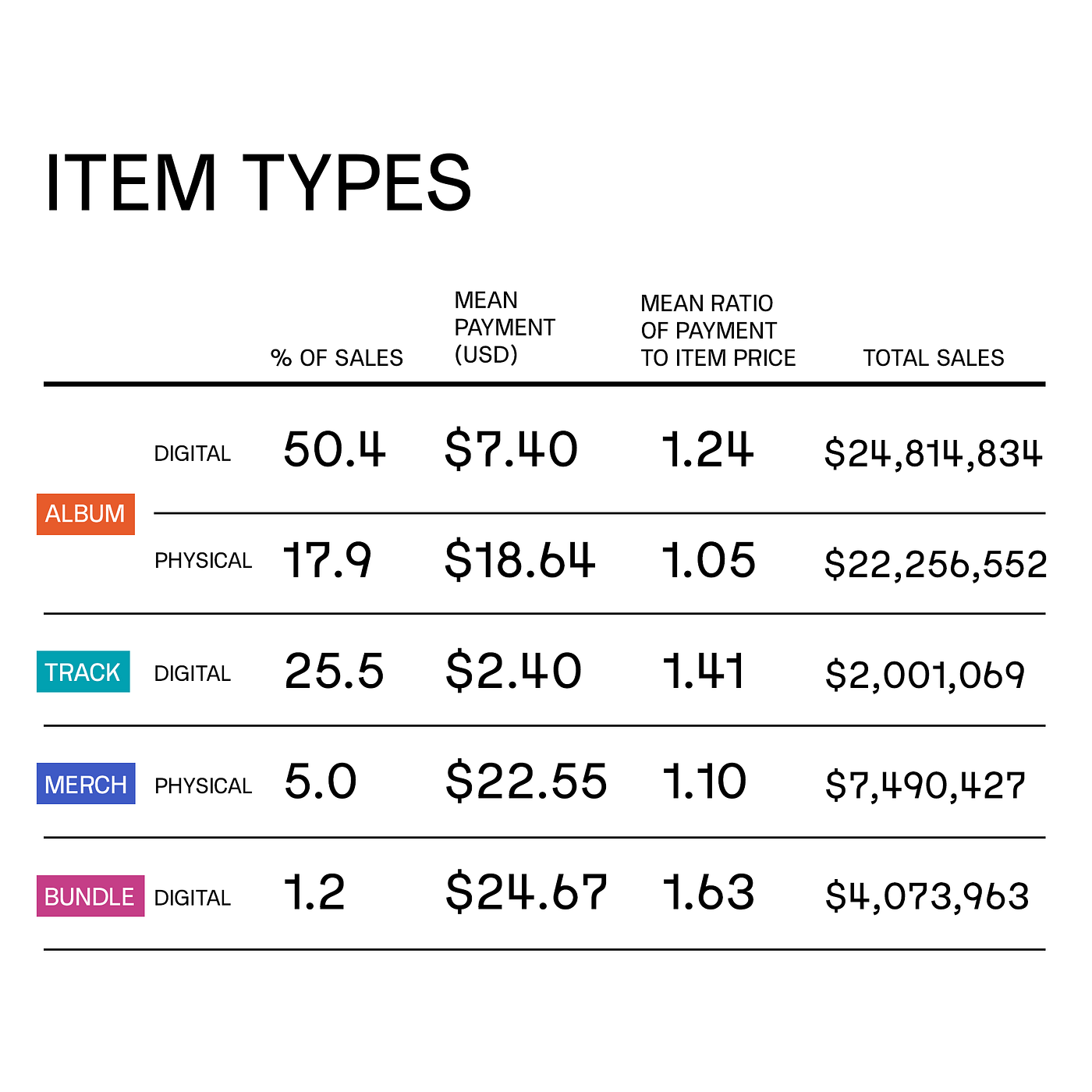
This is how sales break down by item type. As a brief notation, "Package" refers to digital discographies, in which artists sell all or many of their albums for a discount. The ratios here include just items whose list prices were >$0.
Bandcamp is at present one of the largest sellers of physical music — vinyl, CDs, cassette tapes — anywhere in the world. Concrete items account for 22.9 percent of all sales, merely make up 49.1 percent of money spent. That outsize share more often than not comes from physical albums, which alone constitute 36.7 percentage of all money spent.
Cost might modulate generosity to some extent, as people pay more for lower priced tracks than for digital albums. Although artists accuse more for their bundles than merch and physical albums, people nevertheless elect to pay even more for them than those physical alternatives. Additionally, people aren't less generous when paying for the typically more expensive merch than they are for physical albums. Removing outliers changes the hateful ratio for each product category, merely information technology doesn't change this overall relationship.
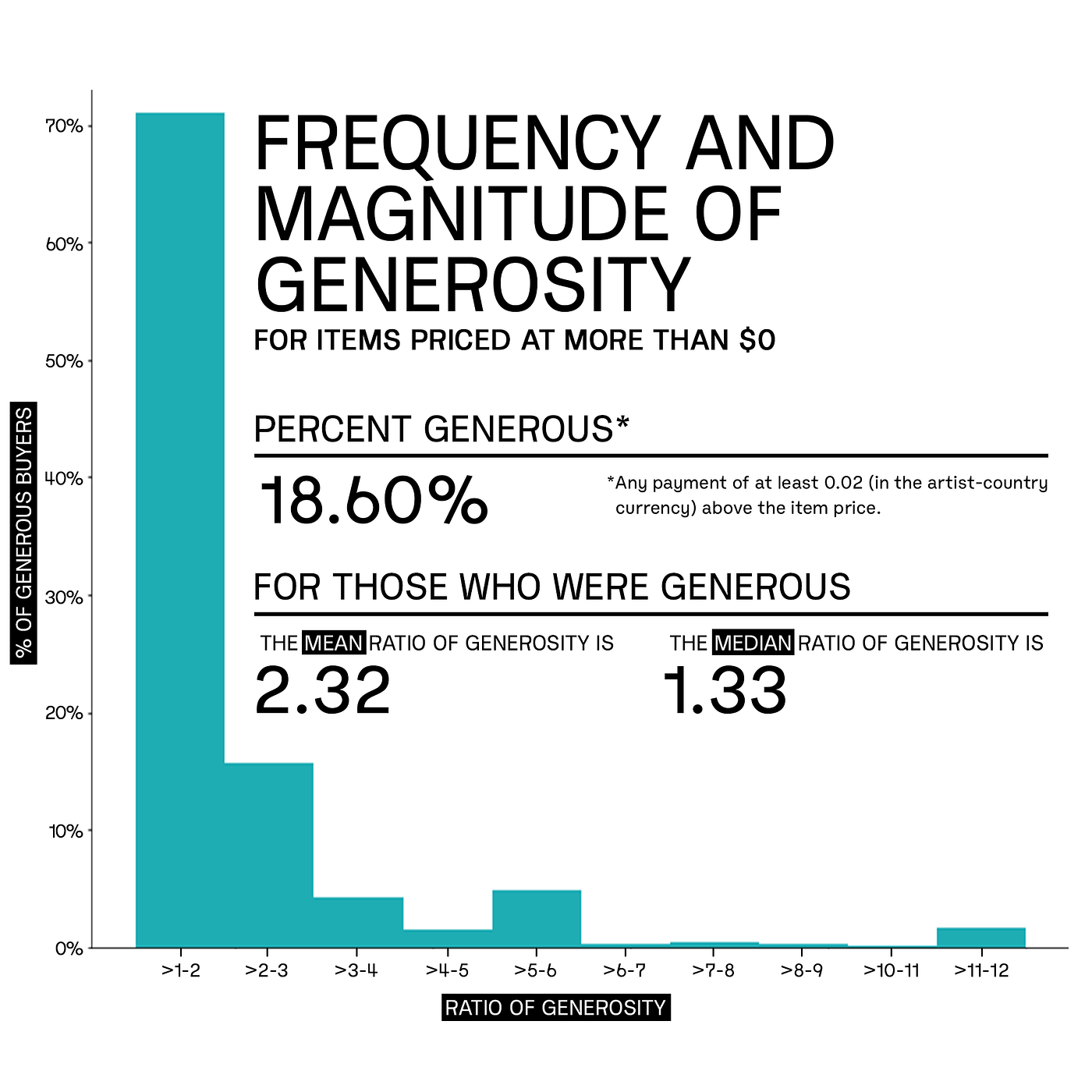
Determining whether or not a buyer behaved generously — i.e., whether they paid more than they had to — is an cryptic undertaking. A basic comparing of whether they paid annihilation to a higher place the minimum runs into a few questions. If someone rounds up a $3.99 item to $4, are they generous? What about if someone pays anything above $0 for a pure PWYW product? And since the buyer has to pay something to encompass processing fees (which usually works out to around $0.forty), how do y'all determine when they're just paying the barest minimum?
For the purposes of this study, including this graph and all others in which nosotros explore the term, "generosity" refers to any payment of at least two cents/pence/etc. higher up the detail price. This ideally controls against people who are only rounding up the penny (or whatsoever pennies might exist in the seller's country), and signals some sort of generous intent. Additionally, nosotros only examine items that take price floors, since instituting a threshold would be a doomed enterprise, given the impossibility of setting a single standard that would make sense across every currency.
The ratios here only apply to people who paid at least at the generosity threshold of >=ii cents/pence/etc. to a higher place the minimum. That means that, different the regular payment ratio in the first graph, the mean and median don't include sales for which the sales price and item price were the aforementioned. We use both metrics in other graphs and will indicate when each is being used.
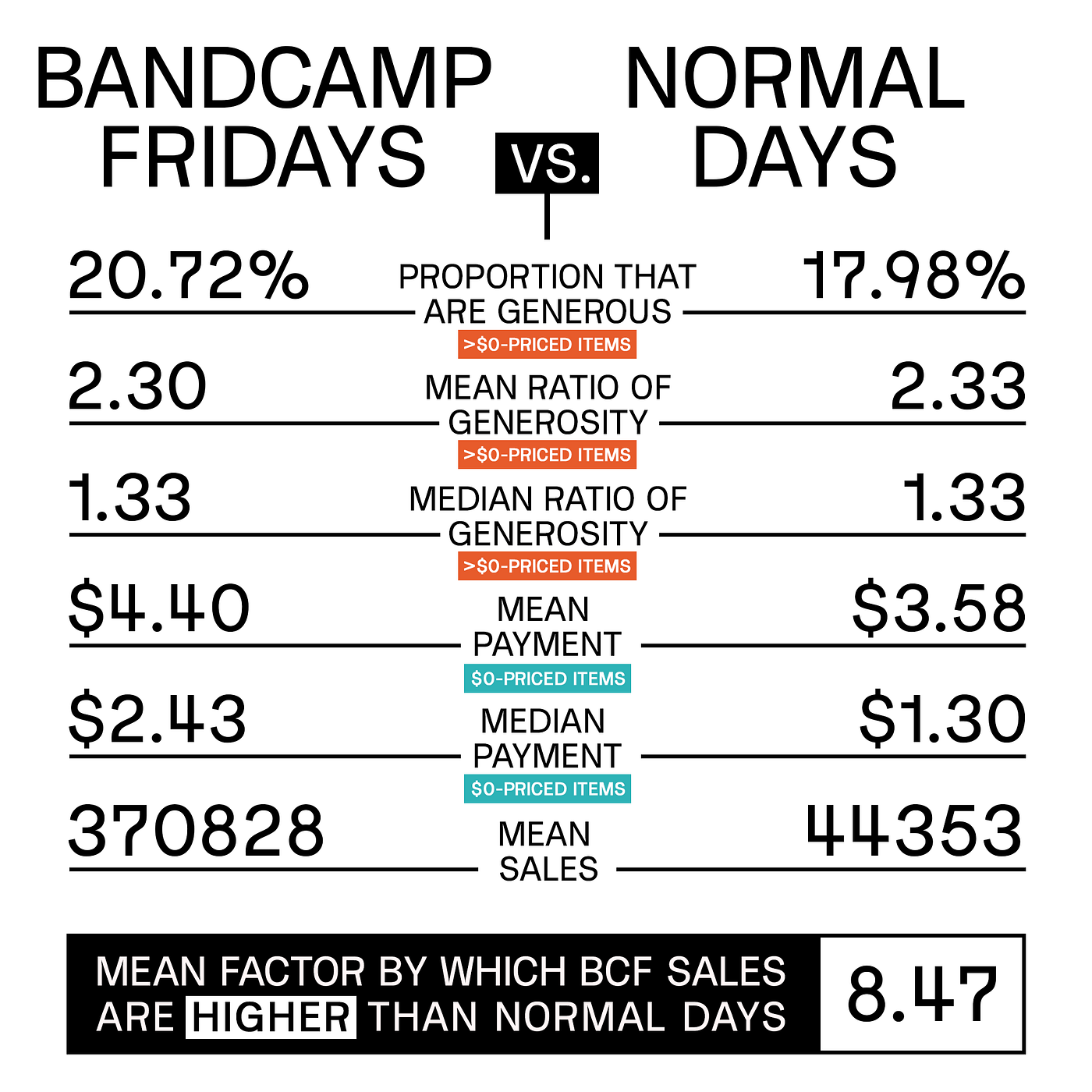
In March 2020, the company launched the first Bandcamp Friday, an initiative to support artists past waiving the fifteen-percent cut it commonly takes in sales. The event was then pop² that the company has continued holding them on the first Fri of every month since.
Something interesting shows upwards when y'all look at the buyer behavior on BCF and normal days side-by-side. A little under 3 percent more people pay at or in a higher place the generosity threshold on BCF than on normal days, which is perchance meaning, but maybe not.³ But while the magnitude of that generosity is the same for items with price floors, people spend much more than on $0-priced items on BCF than they do on all other days.
This might happen because of what behavioral economists take dubbed framing, in which buyers comport co-ordinate to signals they're given. On BCF, the context of the purchase is a special day meant for supporting artists — a behavior typically thought of as altruistic. With $0-priced items, this betoken might come through more clearly than with items that have prices, which act as their own competing signals.
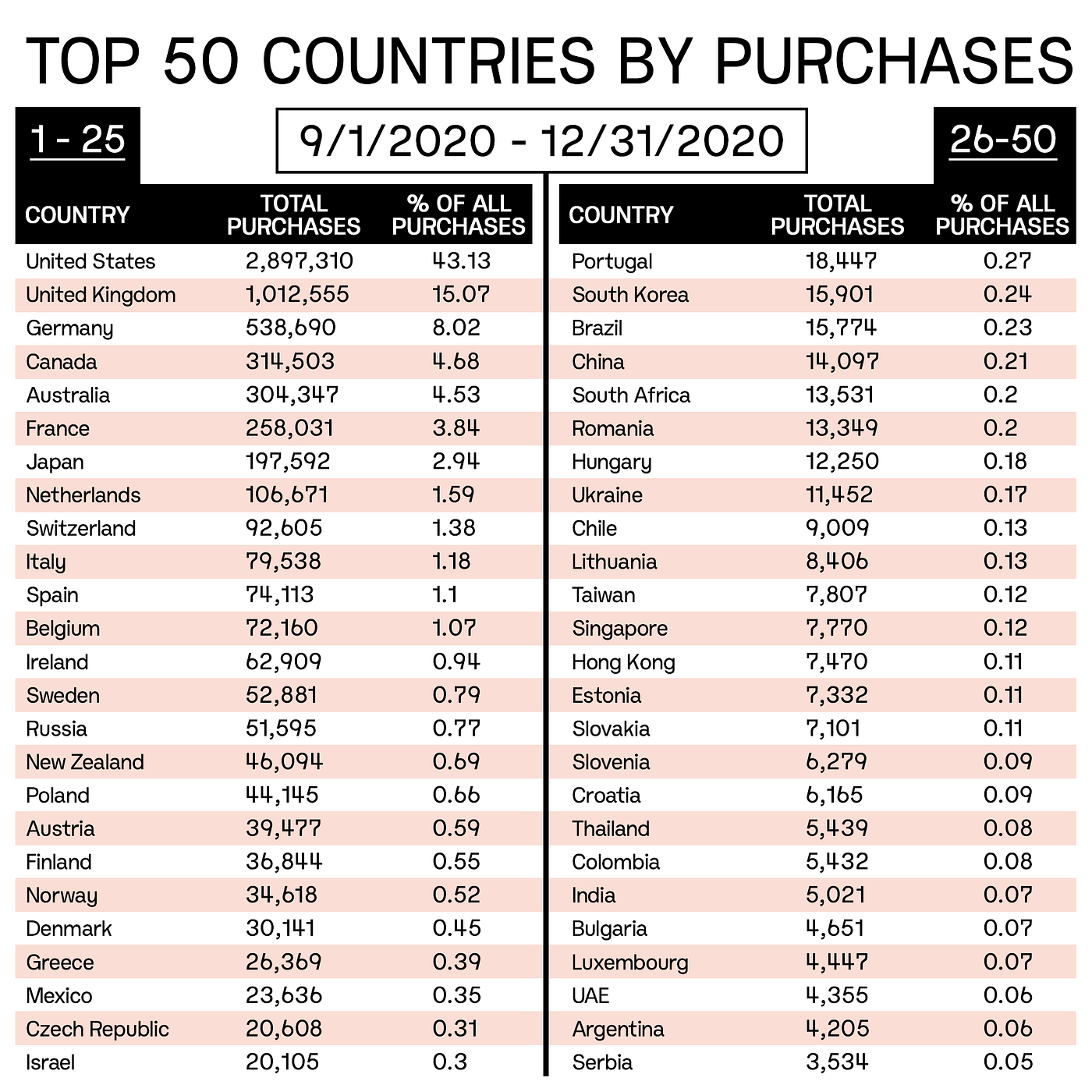
Geographically, Bandcamp is a largely American platform. A large plurality of its sales come from the United States, and a niggling more 75 per centum of all sales come up from the acme five countries, only one of which — Germany — is non predominantly English language-speaking.
At the aforementioned time, Bandcamp's architecture has proven flexible plenty to requite the platform staggering reach: users gravitate to the site from just about everywhere on earth, with representation across regions, languages, and global income brackets.
The precise extent to which activity on Bandcamp correlates with state population wasn't explored. At a glance, no obvious relationship between the two variables exists that would wholly explain the make-up of this list, which would imply the variance comes from elsewhere — per-capita income, the apply of other means for listening and buying music, cultural predilections, and so on.
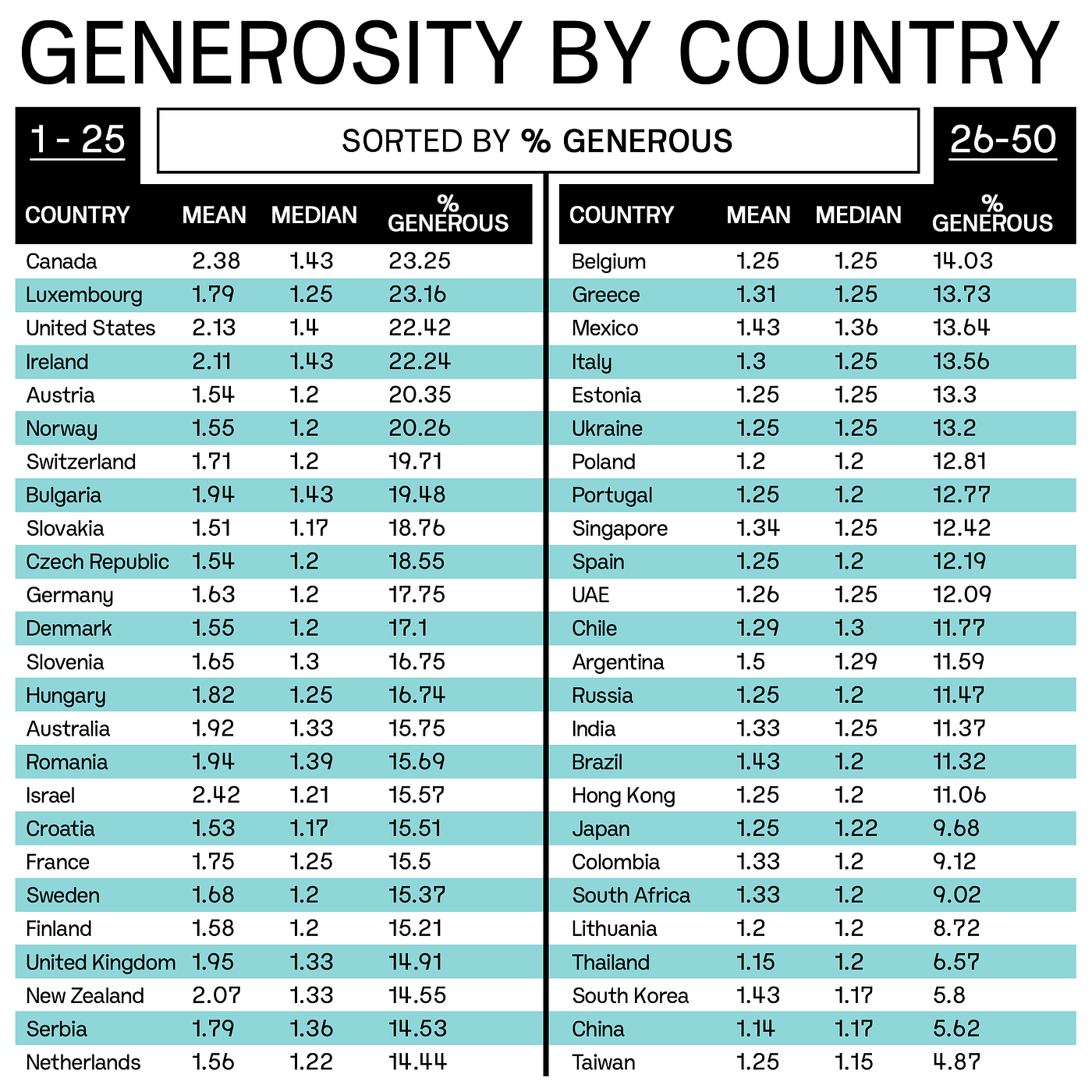
This is how the generosity calculations break down for each of the top 50 countries. The hateful and median hither are measures of the ratio of generosity — i.eastward., for the people who did spend >= 2 cents/pence/etc. above the particular cost, the magnitude past which they did so.⁴
Nothing was controlled for in determining the percentage of generous buyers, including currency, per-capita income, etc. Were such controls included, the countries might shift around, or they might non. What is extremely unlikely, though, is a complete flattening of the differences captured by this metric, and the results at least indicate to geography as a variable in determining why people pay what they do.

Next to each land is a measure of how much buyers in that state pay artists in their own countries compared to how much they pay artists from other countries. To illustrate this, allow'south say you accept a Nigerian creative person and a Nigerian buyer. The artist prices their detail at ₦800, and the heir-apparent pays ₦1600. The ratio is two. Now let'due south say that same buyer purchases an album priced at €1 from an creative person in French republic, and they pay €1,fifty. The ratio is i.5. If that heir-apparent were the simply heir-apparent in Nigeria, and these were the only purchases they made, so Nigeria's ratio in this chart would exist 2 / 1.five = one.33. A ratio greater than 1 indicates that the country's users are spending more on domestic purchases than they are on international ones, while a ratio lower than one would mean the opposite.
On average, buyers are more generous to artists in their own countries. This is not specific to certain countries or regions, and it appears to accept nothing to do with relative currency strength. It is true for every unmarried country in the top fifty countries studied, and it is probably true for those across the top fifty as well.
Fully elucidating the pregnant of this graph requires volumes; in an earlier formulation of this project, it was the study's main focus. Just we're not even halfway done, and so we're going to keep this part short: People are compelled to spend money on things with which they cocky-place.⁵
The most reasonable interpretation of this graph is that it captures multiple moments of shared self-identification: people who know each other,⁶ people who feel analogousness for a local geography, the shared culture more likely to emerge within a country, and even the likelihood that the experience of the creative person results in music more than likely to resonate with that of the listener.
What's important is that the many synapses of identity and a sense of being fire in dissimilar ways, and a shared nationality casts a cyberspace broad enough to capture many of them at the same time — all of this in spite of Bandcamp being a platform that otherwise facilitates the globalization of music.
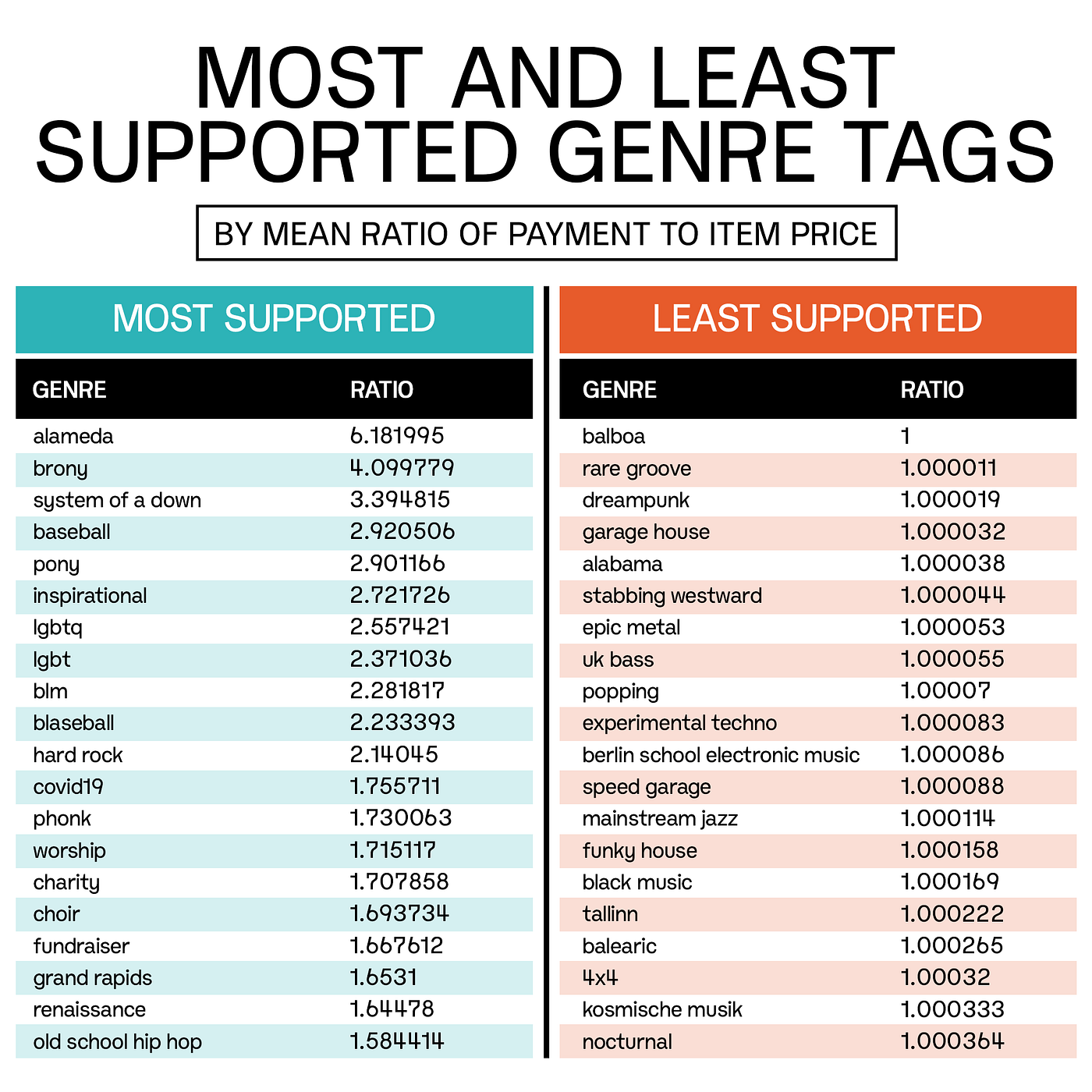
For this chart, we analyzed merely albums (non tracks) priced between $1 and $ten,⁷ and but genre tags that occurred in at least 500 sales. Nosotros explored the challenge of analyzing Bandcamp'southward genre tags previously, equally artists are free to attach whatever tags they like. Digging more deeply into what each of these genres actually refers to both affirms and complicates the hypothesis of connection and identity that emerged in the previous graph.
For example, "Brony", "BLM", and "LGBT"/"LGBTQ" are relatively clear instances of identity-centered tags. "Charity" and "Fundraiser" by themselve are not. It turns out many of these tags are in fact reflecting both types of affiliation.
The genre tag "Alameda" is a reference to the city in the Bay Area. The only album in this dataset with the "Alameda" tag is Ska Against Racism, a compilation whose proceeds went to anti-racist organizations. Similarly, "System of a Down" refers to that band's release of a two-rails EP to raise money for victims of the Armenia-Azerbaijan conflict.⁸ The "Hard Rock" tag is disproportionately associated with that same EP, a co-occurrence similar to that of "Brony" and "Pony". Even "LGBT"/"LGBTQ" is non strictly identitarian, equally one of its highest-selling, highest-ratio albums was associated with a charitable cause.⁹ The high ratio of "Blaseball"/"Baseball game," a pair of genres associated with the Seattle ring The Garages, is primarily captured in an album whose proceeds went to a children's charity.
Discussion
Where does this exit united states? What matters and what doesn't?
The point is that it all matters. The particular type matters and the locations of the parties on both sides of the transaction affair. The charitable nature of the sale matters, and the identity of the seller matters. It matters whether heir-apparent and seller have met or whether they're strangers. Whether an item is priced at $0 or priced at $twenty, whether information technology'south on a twenty-four hours when the artist is reaping the entire sale or just about of it — those thing too. Everything in the data matters, and near everything beyond the data as well probably matters, from the manner the particular is described on its folio to the number of tracks in an album to whether information technology's a limited edition to the album fine art.
And in one case you've found everything you lot tin can measure directly from Bandcamp'due south data, you'll have to account for all the things that you tin't. Was the buyer in beloved or suffering a manic episode when they made the buy? Did they grow up with lots of music effectually? Do they live in a metropolitan expanse of more than ane one thousand thousand people? Are they chronic nicotine users?
Nosotros're halfway washed with this report, and hopefully you read to the terminate. But if you don't, go out with this: Bandcamp has get an extremely rare blazon of company, a profitable startup, by doing nil more than providing a threadbare platform for the cluttered variables of human experience to interact during economic transactions. This basic model is so constructive that it works in spite of every other shortcoming the site suffers from.
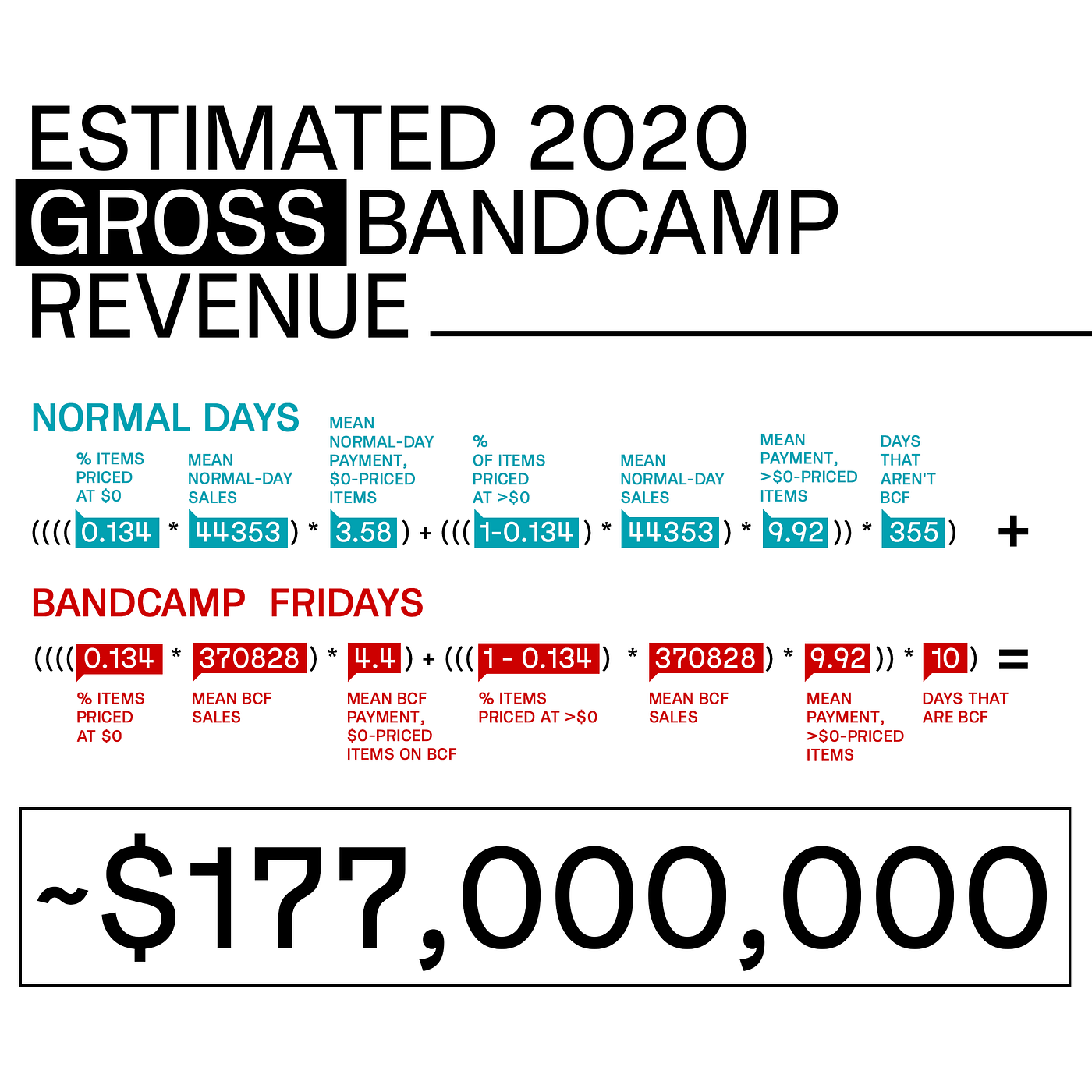
That Bandcamp is in fact both profitable and a startup may come equally a surprise to some. In 2010, Bandcamp received two Series A investments: one from the Menlo Park-based venture business firm True Ventures, and one from the investor Brad Garlinghouse. True Ventures' successful exits include Peloton and Fitbit, which both went public, as well every bit Ring, which was acquired by Amazon. Garlinghouse has since 2017 been the CEO of Ripple, which as of the date of writing this is the seventh largest cryptocurrency by market place cap, and in the 2017 boom saw its value surge by more than than 3,600 percent.
Doing a scrap of napkin math, this is what we estimate the company's total revenue to have been concluding year, including BCF sales, and accounting for a few of the higher-level distinctions in payments based on item prices and so on. Nosotros did not accept into account differences in item types beyond albums vs. tracks.
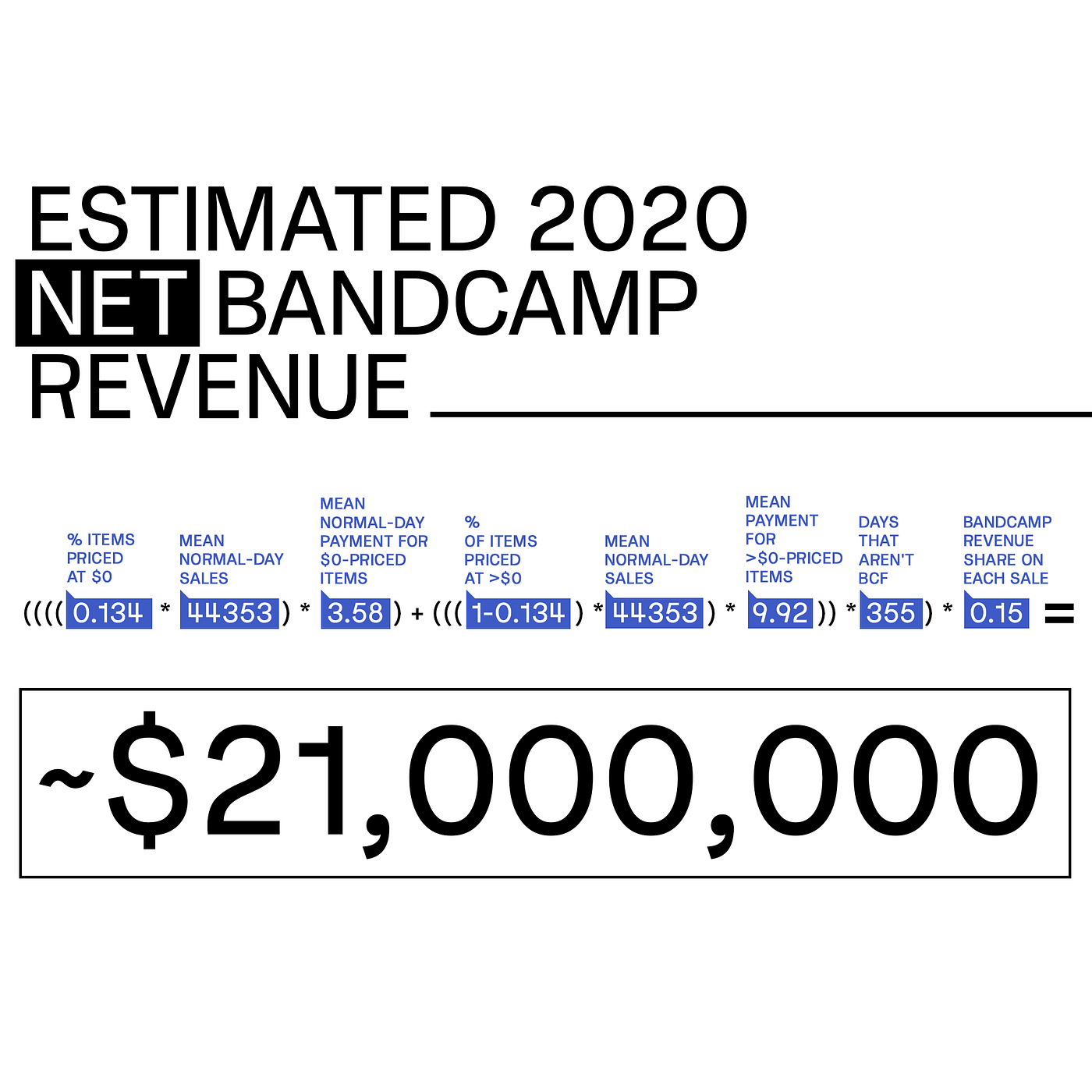
And this is what we estimate the company made last yr from its 15-percent fee. This number does not include BCF sales and similarly accounts for the differences in prices based on normal days vs. BCF, as well as particular prices.
Diamond, the Bandcamp CEO, has said his company has been profitable since 2012. If we had no other information than this gauge alone, we'd believe him. $21 meg is more than enough to encompass the company's operating costs, including the salaries of its employees, the costs of its servers, and its hire on both its office and its physical tape shop in Oakland.
But we have more just this estimate. We know the company hasn't taken some other investment since its 2010 Series A and the lights are still on. Nosotros know it hasn't been cannibalized by a individual equity company who saw opportunity in a distressed asset. In that location's no reason to incertitude Diamond's claim.
With that in mind, let'south look at one concluding graph.
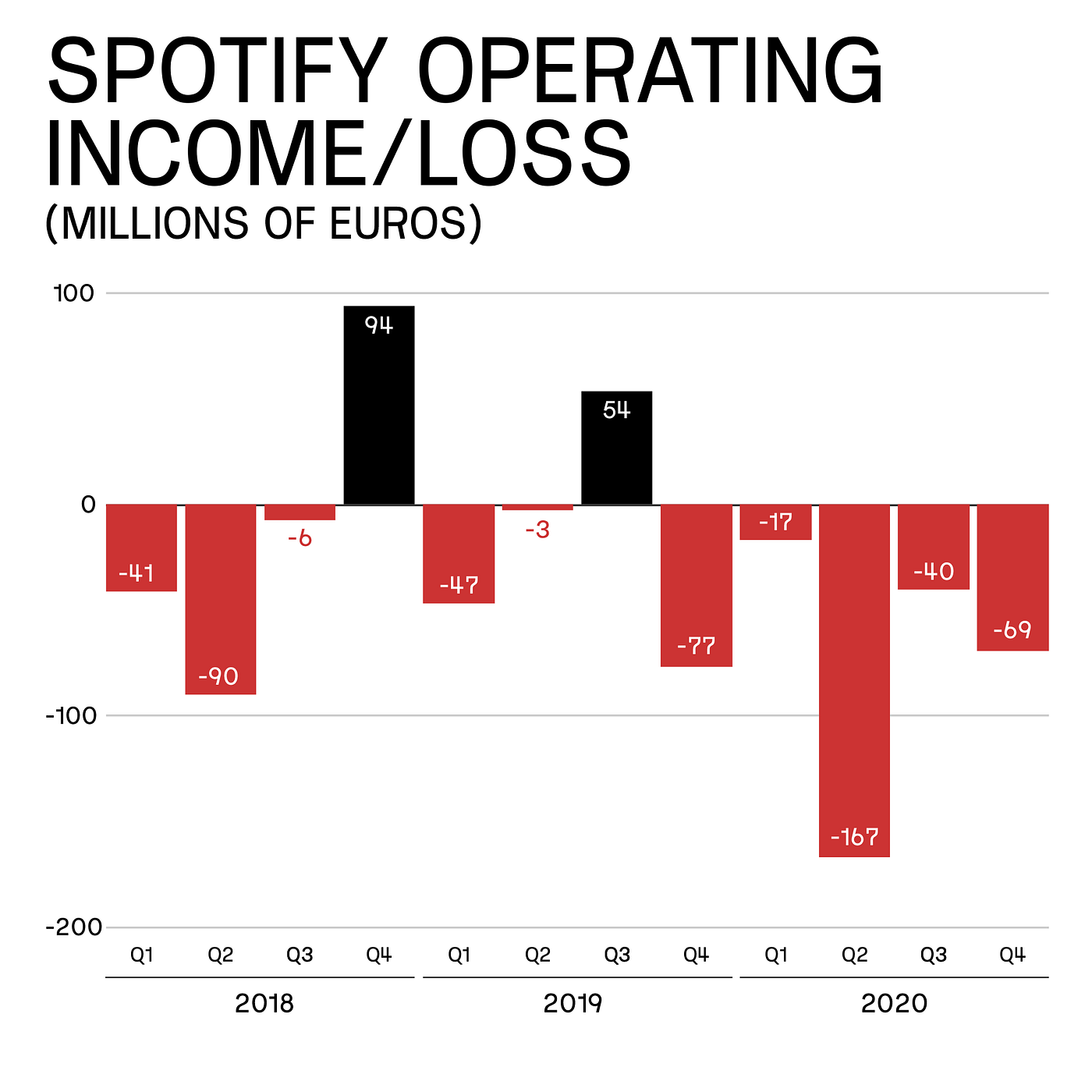
Every bit unaware as people might be that Bandcamp is both profitable and a startup, they're also oft unaware that Spotify is deeply unprofitable. For the most part, Spotify does zero but lose money. Ownership sectional rights to podcasts and paying large record labels licensing fees while charging users no more than $9.99 (a monthly subscription fee the visitor may raise), most of whom cull not to pay, is expensive.
This is considering Spotify'due south understanding of humans as economic actors is almost maximally reductive, blowsy, and fundamentally flawed.
Its misconception begins with a straightforward musical misconception: given a listener's mood, Spotify should provide them with music to friction match that mood. This has been the explicit mission statement of CEO Daniel Ek from the beginning, and it was the idea behind its "music for every mood" advertising campaign, which it ran until terminal year. If someone is going for a walk in the park in autumn, they should be provided with Autumn Walk music. If they've cleaved up with someone, they should exist provided with Pause Up music. If you've ever encountered a ridiculously named Spotify-curated playlist like DayDreamer, Pianoforte in the Background, or Cinematic Chillout, yous've glimpsed this appetite.
The end game here isn't difficult to fathom: If fall walks and solar day dreaming are all-time accompanied past sure music, and we can figure out what those sounds are, why have artists make them at all? The visitor has intimated at this future so hard every bit to almost issue a press release. Meanwhile, the visitor has pursued authorisation through exclusive deals with star podcasters similar Joe Rogan and the acquisition of companies like Gimlet Media, effectively buying up podcast marketplace share in an attempt to monopolize the market and control the equivalent of the Google Ads of audio advertisement.
In both regards, Spotify is pursuing the twin prongs of a standard Silicon Valley business model, in which a company burns investor cash until humans have been removed entirely (a la Uber with self-driving cars) and/or until there'due south most nowhere else left for consumers to go to get what they previously purchased from a diversity of sources (a la Amazon). Doing the first thing doesn't always pan out, as ridesharing companies have discovered. And doing the second both takes a long time and is only possible because of a weak antitrust apparatus in the United states that has for decades immune predatory pricing (i.e., pricing beneath price to push out competitors) and no-questions-asked mergers and acquisitions — and that appliance is apace course correcting.
But Spotify's business is congenital on more delusion and illegality — it's likewise a patently stupid model that disregards the past few decades of behavioral economics research and insists on seeing users equally rational actors who simply seek the most appurtenances for the everyman price.
Every bit Chris Golinski, whose PhD dissertation at UC-San Diego examined Bandcamp users, pointed out to us, Spotify'due south model ignores even the basic principle that xx per centum of buyers normally business relationship for fourscore percent of purchases. Instead, the value of each Spotify user is capped at a monthly subscription cost.¹⁰ By denying buyers the possibility of direct economic relationships with sellers, Spotify has no pick only to continue to pursue its delusional, illegal, stupid business concern model, which is less interested in finding ways for people to pay for music than in popularizing a mode of listening that people only begrudgingly pay for.
Then Bandcamp is assisting and Spotify is not. One is built on the creation of value, the other on speculative fervor. Bandcamp built a modern business model on what often feels like outmoded tech, while Spotify built an outmoded business model on modern tech.
Why do investors pour money into one and not the other? Why are Truthful Ventures and Garlinghouse, who, as the company's only listed investors, most likely sit on Bandcamp'southward board, not pushing for the visitor to modernize its compages, aggressively market itself, and demand all mode of things venture investors practice to effectively put a gun to CEOs' heads and tell them to grow or die?
Hither's a full theorize that could be completely wrong, simply is one possibility all the same:
Ironically, information technology could be considering of the visitor's very profitability. The idea of venture investment is that in a portfolio of ten companies, 9 of them fail and one of them 100x'due south. Bandcamp has neither failed nor grown stratospherically. Instead, it has become a moderately assisting visitor without any expressed intent to take over the globe. In doing and so, it has become less like the hyper-growth stock Valley investors chase and more similar a corporate bail or IBM stock in the 90'due south that reliably pays out dividends only won't make anyone as rich as Peloton or Ripple did. Further investment becomes a needless risk that jeopardizes a safe source of income.
If this is true, in that location are two developments that could unmoor this complacency.
First, the bets investors make that a kickoff-upward might somewhen 100x have at to the lowest degree in part depended on illegal action in the markets that get unchallenged by regulators. Companies like Facebook, Amazon and Google grew to their electric current sizes past pursuing strategies that even politically moderate policy makers at present recognize as criminal. As they causeless their sizes, they likewise bought upwardly portfolio companies from venture firms, allowing investors to exit. Both of these exit paths — becoming a monopoly or being acquired past ane — could shrink as regulators examine the possibility of breaking up tech giants, and equally they more than closely scrutinize acquisitions.
2d, more than a decade later on Bandcamp'due south 2008 founding, other investors, founders, and sellers have discovered that businesses that do facilitate economic relationships between sellers and customers — that permit the endless variables interact as they volition — are in fact cheaper to beginning and invest in and tin can become successful much more than quickly. About lxx percent of Spotify's costs get to licensing fees with tape companies. Patreon, OnlyFans, and Substack are stuck with no such costs, while also leveraging the varieties of economic experience, allowing people to fulfill the multitude of impulses they have to pay for things.
But every bit nosotros were wrapping upward this study, Twitter and Square CEO Jack Dorsey appear that Foursquare would acquire Tidal, the long beleaguered Norweigian music streaming service — an announcement that was preceded by Twitter's bid to larn newsletter platform Revue. "Square created ecosystems of tools for sellers & individuals, and we'll do the aforementioned for artists," Dorsey said in his tweet thread on the Tidal acquisition. "We'll work on entirely new listening experiences to bring fans closer together, simple integrations for merch sales, modern collaboration tools, and new complementary revenue streams."
It'south unclear precisely what Jack'southward enthusiasm for Tidal and Revue are. A worst example scenario probably involves NFTs. A less complicated and peradventure more probable scenario is that this is just the new convention for artistic platforms. Buyers want to directly pay creators for stuff, creators want to get paid. Disallowment world domination, information technology'south more assisting to exist a platform that allows that elemental transaction to happen than it is to refuse information technology.
If these are the signals the market place is in fact sending, it could hateful that Bandcamp is no longer the corporate bail or the blueish chip stock, simply closer to the growth visitor True Ventures and Garlinghouse hoped it might exist when they offset invested a decade agone.
With that in listen, hither is a very incomplete list of things Bandcamp should practise.
Commencement, the company should extricate itself from a state of technological and branding inertia. Bandcamp, equally much equally it has endeared itself to artists and listeners (and, it should get without saying at this point, to us), the platform has felt similar it calcified right after it was created. The site is boring. Elements of its layout are weirdly counterintuitive. You can't download music in the app, and the app allows only low-quality streaming.¹¹ The API offers no meaningful ways to integrate the platform with exterior services.
At the aforementioned time, beyond Bandcamp Daily — the site'south in-house music publication — and a concrete record shop in downtown Oakland that most people will never encounter, the company seems to have no marketing, mostly resorting to artists themselves to marketplace the platform for their own work. If we described the extent to which our research led us to people who have not fifty-fifty heard of Bandcamp (and somewhat harrowingly, this group includes decision makers at nontrivial record labels), the visitor'due south officers would feel rightfully perturbed.
The company should also footstep into a more experimental mode of operation that a totally behaviorally oriented business concern model demands to fully work. If people spend more on artists with whom they share a city, see if directly promoting piece of work in their cities induces more spending. If something pops up similar Buy Music Lodge, a site that is an independently created way of sharing Bandcamp playlists and recommendations, acquire the site and integrate it into the app.¹² Build out the API so that, for instance, NTS Radio DJs can hands integrate the album/rails pages into rail lists.¹³ And so on.
Second, the company should actively entice more large artists to release music on the platform to not only bring in more than revenue, just also to normalize the platform beyond its niche position. Convince a few larger artists to release an EP not available on streaming platforms¹⁴ and see what happens. Phoebe Bridgers, an artist who according to Spotify popularity scores is exactly on par with Charli XCX, brought in more than $178,000 from a single express edition rails released exclusively on Bandcamp that raised money for charity. What would happen if none of it went to charity?¹⁵ 10 percentage of information technology? What if it were a full album instead of a track?
Once more, we don't know, but the sale of the track does begin to give lie to the merits that the fans of larger artists are passively absorbant of whatsoever sound the artist emits — that at that place is in fact a relationship there, and equally such, in that location is an economics. And while the data on how popularity modulates willingness to pay is unclear,17 Golinski's research ended that, at the very least, people who like more popular artists are not therefore less likely to use Bandcamp itself. Nevertheless, it's worth recounting that the willingness of Radiohead fans to voluntarily pay the band was the company'due south foundational ascertainment.
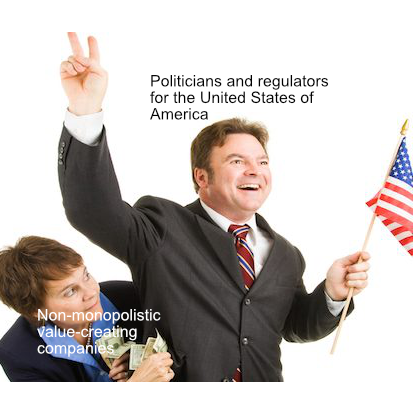
3rd, since all our fates are intertwined and things in the universe are connected and so on, Bandcamp should recognize that it tin grow the nigh nether certain market weather that favor it. The conditions near beneficial to Bandcamp are those that favor value creation and that disfavor empty speculation and criminality. To that end, the company should consider meeting with other companies that stand to benefit from rigorous antitrust enforcement, similar DuckDuckGo, Affinity, and a whole host of others, form a trade group, and hire some lobbyists.
Right at present, the only related group that exists is the Coalition for App Fairness, a trade group formed by Basecamp and Ballsy Games primarily interested in reducing Apple's 30-pct app shop fees. Reducing these fees is, in the long run, probably important for Bandcamp to reach a certain level of growth: The entire reason that Bandcamp does not let in-app purchases is so that it tin can preserve its revenue separate with artists without having to also cutting in a trillion-dollar company. Every bit of this writing, the Coalition has already successfully gotten the Arizona House of Representatives to pass a bill that would force Apple and Google to allow alternative payment methods to circumvent their gatekeeping.
Bandcamp should probably bring together, but it should get beyond this. I of the Coalition's members is Spotify, which has for years ironically accused Apple and Google of monopolistic behavior. This is the perhaps the only antitrust issue Spotify stands to gain from fixing. In this instance, Spotify's and Bandcamp's interests are unusually aligned. But the types of market place atmospheric condition that would benefit Bandcamp, DuckDuckGo, Analogousness, and the others extend far beyond the confines of the app store and into the very bones of our economy. So far as we know, there is currently no trade grouping advocating in this expanse. Bandcamp should help commencement it. If it turns out ane exists, information technology should join.
Only despite contempo anti-monopoly efforts by US legislators — many of which volition directly affect today's music industry — Bandcamp's all-time moves may be beyond N America. A recent written report tabled by UCL London describes the broader crises within creative industries within the Britain, describing a significant loss of agency and income for all emergent and established creative sectors. Alongside local economic policy, the report identifies monopolized tech platforms as a chief commuter of this crunch. Bandcamp stands uniquely positioned against this form of antitrust, and its expertise could inform intellectual belongings reform, digital distribution legislation, pricing thresholds, ownership, and more than as office of a larger strategic position.

Finally, if whatever of these suggestions are also much for the visitor's by investors to consume (conjecturally/hypothetically/etc.), the founders and/or employees should see if in that location'southward a way to buy them out. Hopefully the opposite is true, and the investors actually understand that starting a new Spotify is not smart, that the political tides accept changed, and that the odds of Bandcamp becoming the portfolio whale they hoped for in the beginning, by creating value instead of violating antitrust regulations, is greater now than information technology was x years ago.
Conclusion
We'll end on this note:
We think there is plenty information in this written report for different readers to have abroad whatever they find valuable and ignore or dismiss what they don't, so long as they keep in mind the overarching points: That Bandcamp'south model is antifragile and Spotify's is not, which is why Bandcamp is profitable and Spotify is not. We'll add one more non-negotiable takeaway, which is that Bandcamp is a company founded by people who respect music and Spotify is not. This is the ur-distinction betwixt the two from which all others originate.
Spotify will never deliver what its artists endlessly appeal for: Fair remuneration and skilful-faith avenues for artist development that don't involve payola or the equivalent of musical SEO. Information technology volition not practice this because the beingness of music beyond basic hormonal modulation does not interest it, and therefore, the being of musicians does not involvement it. The precise extent to which the aforementioned can be said of Apple Music (the second-largest streaming platform) or Amazon Music (the third) is debatable, simply in most regards, they've made no marked gestures in the opposite direction.
Mayhap all of this is overstating the beingness of competition between the 2 ecosystems; in many ways, they tin can be seen as complementary, as streaming provides an avenue for music discovery and Bandcamp an avenue for economic relationships — Diamond once compared Spotify to the radio, a place to detect new artists. Except that while Bandcamp may encounter streaming platforms as a complement, Amazon, Apple, and Spotify, which have spent the past decade devouring entire markets, rarely see themselves equally complements to anything.
In the grade of this inquiry, one of the states suggested to someone at a record label that publishes its artists' music exclusively on streaming platforms that they should throw a few tracks on Bandcamp and see what happens. The person said they'd bring information technology up to others in the company "every bit an thought for any artists who want to pursue…the 'secret' await."
Every recommendation made here is a facet of a single exhortation: that Bandcamp practice everything it can so that no one sends an email like this e'er over again.
Acknowledgements
Special cheers to Cade Diehm (New Pattern Congress), Chris Golinski (HP), Ayelet Gneezy (UC-San Diego, Rady School of Direction), Minah Jung (NYU, Stern Schoolhouse of Business organization), and Matt Stoller (American Economic Liberties Project) for their conversations and feedback throughout this project.
If you lot liked this report, you lot can sign upwardly for our newsletter here.
If y'all didn't and would like to club a complaint, contact mail@components.one.
Footnotes
¹ Due to its position in the streaming market, its outsized influence on other participants, and our interest in editorial brevity, Spotify is the simply streaming service seriously examined vis à vis Bandcamp in this report. It's worth recognizing that differences do be between Spotify, Amazon, Tidal, Apple, SoundCloud (especially), and so on.
² In the course of this assay, a few disparities arose between the company'southward claims and our results. For instance, the Guardian published that on the first Bandcamp Fri, "fans bought 800,000 records on Bandcamp in 24 hours, totalling $four.3m of music and trade." This raw count is college than any we accept for the four Bandcamp Fridays captured. Nevertheless, the respective sales figures are about the same — the concluding Bandcamp Friday we recorded logged about $iv.7 meg while only containing nearly half the number of sales. It'south unclear why a partial disparity like this exists, but it'southward worth pointing out. Source.⇗
³ i.e., significance testing wasn't run on this.
⁴ Hateful and median ratios both exclude outliers of payment prices more than 3 standard deviations above the hateful for each country.
⁵ Put another style, "People increase the degree to which they cooperate with strangers whom they perceive to exist office of even very minimally-triggered solidarity groups." Source.⇗
⁶ It's hard not to assume that this explains the particularly big ratio for the microstate of Grand duchy of luxembourg.
⁷ We measured the USD cost according to Bandcamp'due south conversion.
⁸ This album folio is no longer available.
⁹ This album page is also no longer available and the verbal charity tin can't be recalled, so the clan with a clemency comes from retention (besides as the >nine ratio the particular anthology has).
¹⁰ Put another way (ane that may make some eyes curlicue, merely any), Bandcamp is antifragile, since past leveraging the diversity of its users' behaviors, it captures multiple local optima of pricing rather than seeking a single global optimum. One of the funnier ironies of the startup globe is how its members profess interest in concepts like antifragility while building companies on the most fragile possible models. The benefits/costs besides cut both ways: As Andrew Wilkinson convincingly argued, even Joe Rogan probably could have made more than coin by turning downward Spotify's deal and directly monetizing his listeners.
¹¹ While the Bandcamp mobile app isn't terribly characteristic rich, the features it does offer work most entirely without incident.
¹² This is not the same every bit an illegal acquisition in which a company either buys marketplace share or competitors. This is, in fact, the blazon of thing legal acquisitions are meant for.
¹³ Or anything, just do literally anything with the API.
¹⁴ Again, this is dissimilar from Spotify's exclusivity deals with Rogan et al. In that case, the company restricted what was a previously open file standard to one that was closed. In this hypothetical, the artist is yet free to sell files, tapes, and so on wherever else they wish. Additionally, even if the artist exclusively released on Bandcamp, the strategy suggested here is that the company only court artists to release on the platform, not bind them in contracts.
¹⁵ She has previously released albums on the platform, simply A) we don't have all the sales in our data, and B) they were not exclusively released there.
Source: https://towardsdatascience.com/why-is-bandcamp-profitable-and-spotify-isnt-3444ad63e7fb
0 Response to "How to Upload a Split on Bandcmap"
Post a Comment