Is Oil Pastel Drawing or Painting
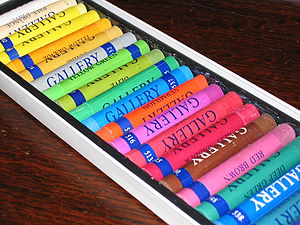
An oil pastel is a painting and drawing medium formed into a stick which consists of pigment mixed with a folder mixture of not-drying oil and wax, in contrast to other pastel sticks which are made with a glue or methyl cellulose binder, and in contrast to wax crayons which are made without oil. The surface of an oil pastel painting is less powdery than i made from gum pastels, but more than difficult to protect with a fixative. Oil pastels are assuming and brilliant. They tin be blended easily but they can suspension easily too.
History [edit]
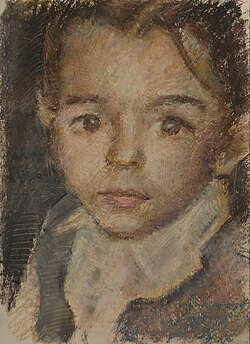
Portrait of a child made from oil pastels.
At the end of World State of war I, Kanae Yamamoto proposed an overhaul of the Japanese education system. He idea that information technology had been geared likewise much towards uncritical absorption of information by false and wanted to promote a less restraining system, a vision he expounded in his book Theory of self-expression which described the Jiyu-ga method, "learning without a instructor". Teachers Rinzo Satake and his brother-in-constabulary Shuku Sasaki read Yamamoto's work and became fanatical supporters. They became keen to implement his ideas by replacing the many hours Japanese children had to spend cartoon ideograms with black Indian ink with free cartoon hours, filled with as much color every bit possible. For this, they decided to produce an improved wax crayon and in 1921 founded the Sakura Cray-Pas Company and began production. The new product was not completely satisfactory, as pigment concentration was low and blending was incommunicable, so in 1924 they decided to develop a high viscosity crayon: the oil pastel. This used a mixture of mashed alkane wax, stearic acid and coconut oil as a folder. Designed equally a relatively cheap, easily applied, colorful medium, oil pastels granted younger artists and students a greater freedom of expression than the expensive chalk-like pastels usually associated with the fine arts. Until the add-on of a stabiliser in 1927, oil pastels came in two types: wintertime pastels with additional oil to forestall hardening and summer pastels with fiddling oil to avoid melting. Country schools could not afford the medium and, suspicious of the very thought of "self-expression" in general, favoured the coloured pencil, a cheaper German invention then widely promoted in Europe as a ways to instill piece of work discipline in immature children.
Oil pastels were an immediate commercial success and other manufacturers were quick to accept upward the idea, such as Dutch company Talens, who began to produce Panda Pastels in 1930. Notwithstanding, none of these were comparable to the professional quality oil pastels produced today. These early products were intended to introduce western art education to Japanese children, and not equally a fine arts medium, although Sakura managed to persuade some avant-garde artists to acquaint themselves with the technique, amid them Pablo Picasso. In 1947, Picasso, who for many years had been unable to procure oil pastels because of the war conditions, convinced Henri Sennelier, a French manufacturer who specialized in loftier quality art products, to develop a fine arts version. In 1949 Sennelier produced the first oil pastels intended for professionals and experienced artists.[1] These were superior in wax viscosity, texture and pigment quality and capable of producing more consistent and attractive work. The Japanese Holbein make of oil pastels appeared in the mid-1980s with both student and professional grades; the latter with a range of 225 colours.
Employ [edit]
Oil pastels can be used straight in dry form; when done lightly, the resulting effects are similar to oil paints. Heavy build-ups can create an about impasto event. Once practical to a surface, the oil pastel paint can be manipulated with a brush moistened in white spirit, turpentine, linseed oil, or another type of vegetable oil or solvent. Alternatively, the cartoon surface tin be oiled earlier drawing or the pastel itself tin be dipped in oil. Some of these solvents pose serious health concerns.[2]
Oil pastels are considered a fast medium because they are easy to paint with and convenient to conduct; for this reason they are frequently used for sketching, but tin can also be used for sustained works. Because oil pastels never dry out completely, they demand to be protected somehow, oftentimes by applying a special fixative to the painting or placing the painting in a sleeve and and then inside a frame. There are some known durability bug: firstly, as the oil doesn't dry, it keeps permeating the newspaper. This process degrades both the paper and the colour layer every bit information technology reduces the flexibility of the latter. A second problem is that the stearic acid makes the paper brittle. Lastly both the stearic acid and the wax will exist prone to efflorescence or "wax bloom", the edifice-upwards of fatty acids and wax on the surface into an opaque white layer. This is easily made transparent once more past gentle polishing with a woolen cloth; but the 3 effects together result in a color layer consisting mainly of brittle stearic acid on pinnacle of brittle newspaper, a combination that volition crumble hands. A long term business is simple evaporation: palmitic acid is frequently nowadays and half of information technology volition have evaporated within 40 years; within 140 years half of the stearic acid will accept disappeared. Impregnation of the unabridged art piece of work by beeswax has been evaluated as a conservation measure.
Surface and techniques [edit]
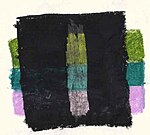
An instance of the scraping downward technique
The surface chosen for oil pastels can have a very dramatic effect on the terminal painting. Paper is a common surface, but this medium tin can exist used on other surfaces including forest, metallic, hardboard (often known as "masonite"), MDF, sail and glass. Many companies make papers specifically for pastels that are suitable for utilize with oil pastels.
Edifice up layers of colour with the oil pastel, called layering, is a very common technique. Other techniques include underpainting and scraping down or sgraffito. Turpentine, or similar liquids such as mineral spirits, are ofttimes used as a blending tool to create a wash upshot similar to some watercolor paintings. Commercially bachelor oil sketching papers are preferred for such technique.
Grades [edit]

A blended moving picture using mineral spirits and oil pastels
There are a number of types of oil pastels, each of which can exist classified as either scholastic, pupil or professional grade.
Scholastic grade is the lowest grade; more often than not the oil pastels are harder and less vibrant than higher grades. It is mostly meant for children or new users of oil pastels, and is fairly inexpensive compared to other grades. The middle grade, student course, is meant for art students and is softer and more vibrant than scholastic grade. They are usually more than expensive. Professional form is the highest course of oil pastel, and are also the softest and most vibrant, but can be very expensive.
Come across also [edit]
- Oil stick
References [edit]
- ^ "Fine art and History Intersect at a Paris Shop". NPR. 2006-07-27. Retrieved 2018-06-17 .
- ^ "Section 10: Painting and Drawing". Ecology Health & Safety | Baylor Academy . Retrieved 2018-09-08 .
Further reading [edit]
- Leslie, Kenneth. Oil Pastel: Materials and Techniques for Today's Artist, Watson-Guptill Publications, 1990. ISBN 0-8230-3310-4.
- M.H.Ellis, "Oil Pastel", in Media and Techniques of Works of Art on Newspaper, New York University Conservation Center of the Institute of Fine Arts, New York, 1999.
- Elliot, John. Oil Pastel: for the Serious Beginner, Watson-Guptill Publications, 2002. ISBN 0-8230-3311-two.
External links [edit]
- The Oil Pastel Society
- https://web.archive.org/web/20070716232500/http://palimpsest.stanford.edu/waac/wn/wn21/wn21-1/wn21-106.html for a discussion of the evaporation and efflorescence.
Source: https://en.wikipedia.org/wiki/Oil_pastel#:~:text=An%20oil%20pastel%20is%20a,which%20are%20made%20without%20oil.
0 Response to "Is Oil Pastel Drawing or Painting"
Post a Comment